If you’ve been on the internet today, you’ve seen them: the stunning, high-definition photos of the Artemis II capsule splashing down in the Pacific Ocean.

This isn’t just about space anymore; it’s about a massive shift in where the world’s smartest money is moving.
Quick Summary: The “Need to Know” Points
- The Event: After 10 days of orbiting the Moon, the Orion spacecraft safely returned on April 10, 2026.
- The Business Hook: This success has unlocked billions in private contracts for 2026 and 2027.
- The Market Impact: Companies like Lockheed Martin and Boeing are seeing record-breaking backlogs as “Space” becomes a reliable commercial sector.
- Your Opportunity: The “Space Economy” is no longer just for billionaires—it’s trickling down into tech stocks, satellite data, and AI.
The Real Reason Business Leaders are Watching
For a long time, space was a “government-only” game. It was expensive and risky. But the Artemis II splashdown changed the narrative. It proved that the modern “Tech Stack” used to build these rockets is actually reliable.
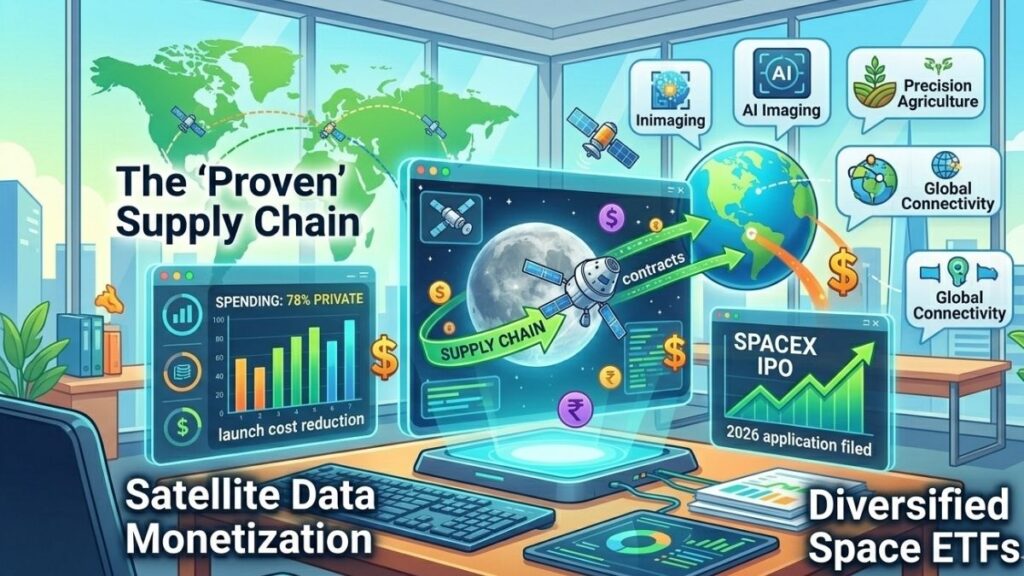
In the business world, reliability equals investment. When investors see a capsule return safely, they stop seeing a “science project” and start seeing a “supply chain.”
The 2026 Space Economy at a Glance
| Company/Entity | Role in Artemis II | Business Outcome |
|---|---|---|
| Lockheed Martin | Orion Spacecraft | 2026 revenue guidance raised to $80B |
| SpaceX | Future Moon Lander | IPO rumors intensified for Q4 2026 |
| NASA | Project Management | $25B+ in annual budget stability |
| Global Investors | Funding Source | 15% increase in Space-Tech ETFs |
From “Baby Born” to Billion-Dollar Industry
We often talk about new businesses being in the “baby stage.” For years, the commercial space industry was exactly that. However, the successful recovery of the Artemis crew (Wiseman, Glover, Koch, and Hansen) is like the industry finally graduating.
Why does this matter to you and your wallet? Because the technology used in these missions doesn’t stay in space. It finds its way into:
- AI & Imaging: The sensors that took those viral “splashdown photos” are being adapted for next-generation medical imaging and autonomous vehicle cameras.
- Global Connectivity: The communication tech tested during the lunar flyby is the blueprint for the 2026 satellite internet explosion.
- Advanced Materials: The heat shields that protected the crew from 5,000°F are already being used to create safer, more efficient batteries for electric cars.
My Opinion: Is it Too Late to Invest?
I get asked this a lot. People think that because they aren’t Elon Musk or Jeff Bezos, they’ve missed the boat. I believe the opposite is true. We are currently in the “Infrastructure Phase.” Just like the early days of the internet when people were laying fiber-optic cables under the ocean, we are now laying the “cables” to the Moon. The real money isn’t just in the rockets; it’s in the data, the software, and the services that support them.
The splashdown photos aren’t just souvenirs; they are proof that the platform is ready for builders.
Key Takeaways for Tech & Finance Enthusiasts
If you want to stay ahead of the curve, keep these three things in your “Profit Stack”:
- Watch the Contractors: Don’t just follow the headlines. Look at the mid-sized tech firms providing the software and sensors for these missions.
- Data is the New Oil: Companies that can process and sell satellite data are the “hidden gems” of 2026.
- The Moon is a Hub: Artemis II was a flyby. Artemis III is a landing. Every successful step makes the “Lunar Economy” a more realistic part of your long-term portfolio.