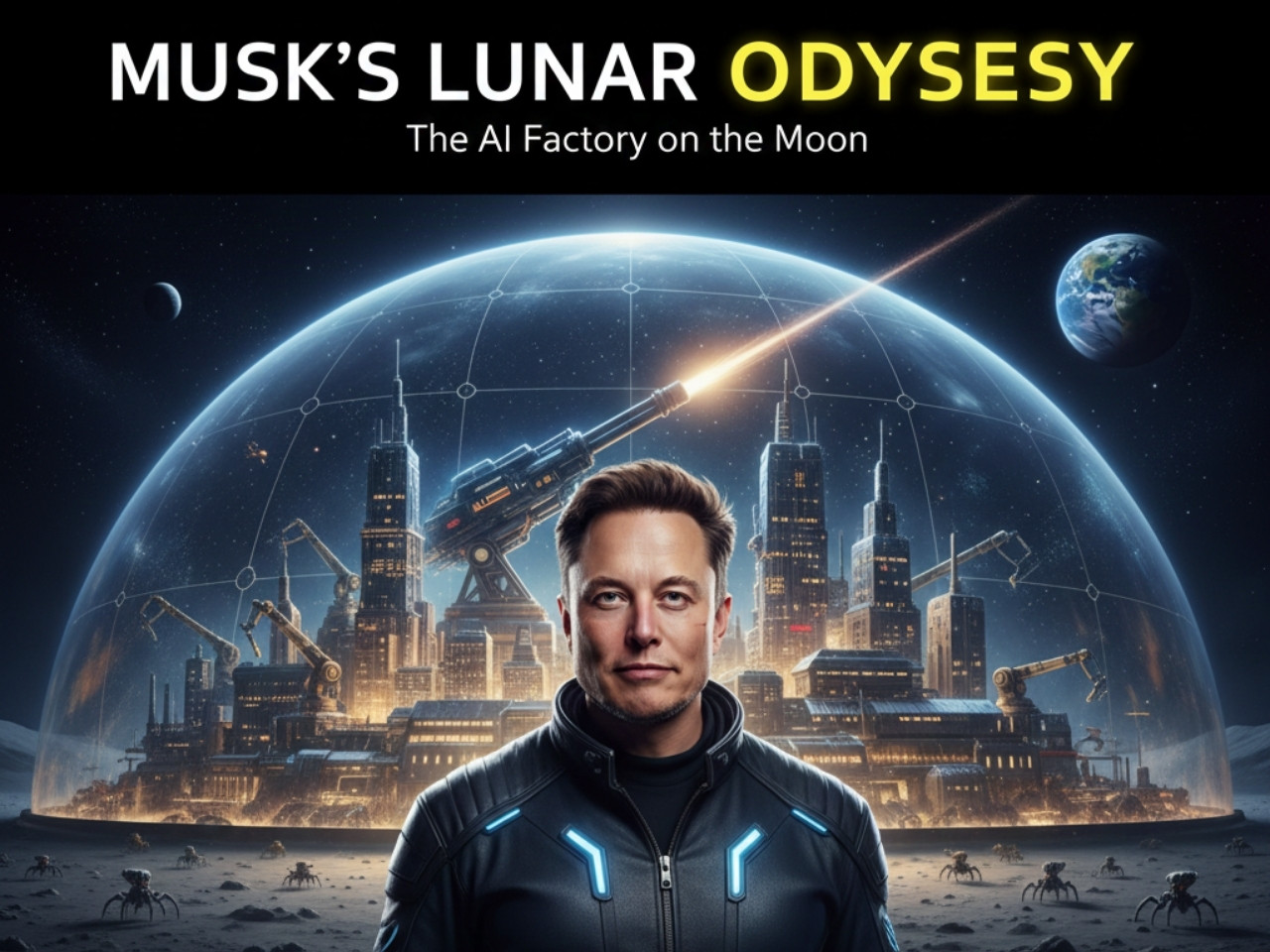
Forget the electric car wars. Elon Musk has moved on. While the world was busy tracking Tesla’s stock, the AI visionary just dropped a bombshell that has shaken the space industry to its core: The Moon is no longer a pitstop—it’s the destination. Musk’s xAI and SpaceX are now pivoting to a ‘Self-Growing Moon City’ within the next 10 years, a feat that would have taken 20 years on Mars. The secret weapon? An AI-powered satellite factory and a lunar ‘Mass Driver’ that could change the economics of the galaxy forever.
The Physics of Profit (Gravity & Cost)
The Gravity Hack: Why 100kg Becomes 16kg
The biggest hurdle to space exploration isn’t technology—it’s Earth’s gravity. Launching a satellite from Earth requires massive rockets and a sea of expensive fuel. But on the Moon, the game changes. Thanks to its low gravity, a 100kg payload effectively behaves like 16kg. This ‘Lunar Discount’ means we can launch more for less. Instead of burning billions in fuel, Musk’s ‘Mass Driver’ can literally ‘shoot’ AI satellites into orbit using electromagnetic energy. It’s not just a factory; it’s the galaxy’s most cost-effective gas station.
Moon vs. Mars (The Logic of Distance)
Why 10 Years? The Reality of 384,000 Kilometers
Why is the Moon winning the race? It’s simple math. The Moon is a mere 3.84 lakh km away, a distance we can bridge every 10 days. Mars, however, is a logistical nightmare. The ‘Launch Window’ for Mars opens only once every 26 months. If you miss that window, you’re stuck.
Moreover, communication with the Moon is near-instant, whereas Mars signals can take up to 20 minutes to reach Earth. For a ‘Self-Growing AI City‘ that relies on real-time data, the Moon is a laboratory; Mars is a death trap. By choosing the Moon, Musk is cutting the timeline from 20 years to less than 10.
| Feature | The Moon | Mars |
| Distance | 384,400 KM | ~225 Million KM (Avg) |
| Launch Window | Every 10 Days | Every 26 Months |
| Comm. Delay | ~1.3 Seconds | Up to 20 Minutes |
| Timeline | Under 10 Years | 20+ Years |
As our data shows, the Moon is “right next door.” We can send supplies or technicians every 10 days. On Mars, if you miss your 26-month window, you are isolated for years. For an AI-driven mission, the Moon is a playground; Mars is a logistical nightmare.
Self-Growing Cities: The AI Integration The most radical part of Musk’s plan is the “Self-Growing” infrastructure. This means the Moon factory won’t be waiting for “bricks and mortar” from Earth.
- 3D Printing: Using lunar soil (regolith) to print structures.
- AI Autonomy: Robots powered by xAI will mine resources and build the factory autonomously.
- No Earth Support: The goal is to reach a point where 100% of the resources are sourced on the Moon, making it a truly independent hub.
The Lunar Endgame
While the dream of the Red Planet remains the ultimate goal for humanity, the road to Mars, it seems, is paved with lunar regolith. By shifting focus to a self-sustaining Moon base, SpaceX isn’t just taking a shortcut; they are building the “Silicon Valley of Space.”
If Musk succeeds in turning the Moon into a fully autonomous, AI-driven manufacturing hub, the question won’t be when we will reach Mars, but how many other worlds we can reach once the Moon becomes our gateway. The 20-year wait for Mars just became a 10-year sprint to the Moon—and the galaxy is watching.